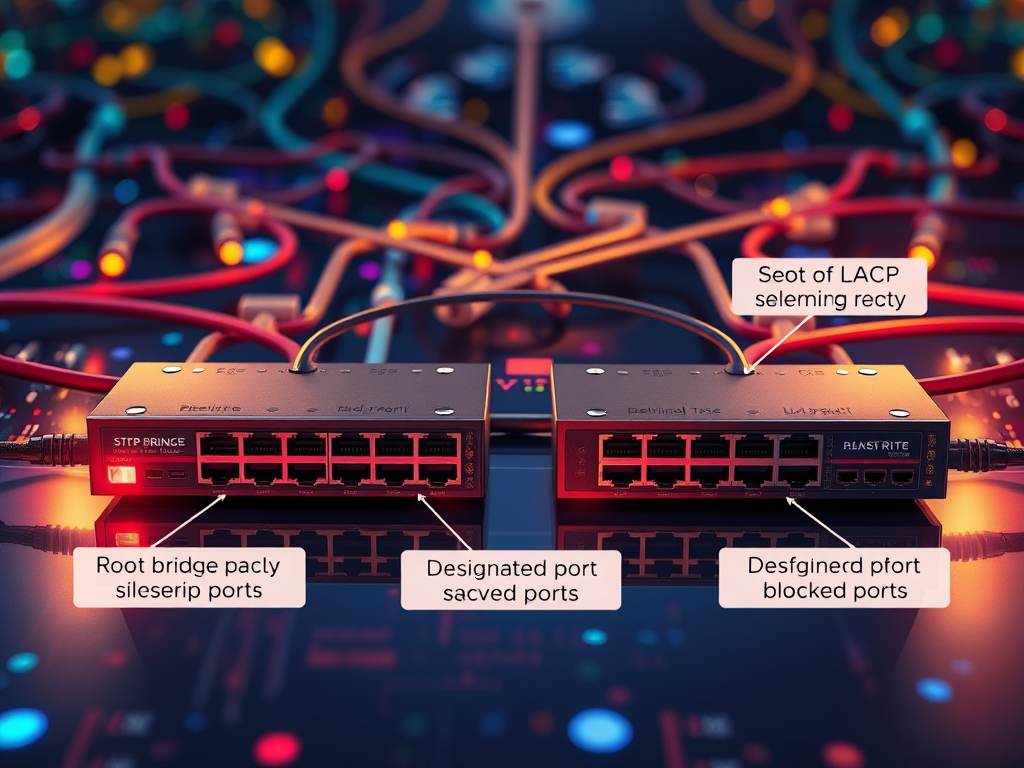
In complex network environments, ensuring seamless communication while avoiding redundancy-induced failures is critical. Spanning Tree Protocol (STP) is a fundamental networking technology designed to achieve this by eliminating switching loops in Ethernet networks. In parallel, Link Aggregation Control Protocol (LACP) provides a solution for creating redundant aggregate connections. However, these protocols have mutually exclusive goals, requiring precise configuration to maintain network stability.
What is STP?
STP, defined in IEEE 802.1D, ensures that each switch in a network maintains a single active path to every other switch, preventing data packets from looping endlessly. A switching loop occurs when multiple paths between switches cause packets to circulate indefinitely, leading to broadcast storms and network congestion.
How Does STP Work?
The mechanism of STP operates through a structured process:
- Bridge Protocol Data Units (BPDUs): Each switch sends out BPDU frames (STP announcements) on all ports.
- Path Calculation: When a switch receives multiple BPDUs from the same switch via different ports, it identifies redundant paths.
- Root Bridge Election: The network designates one switch as the Root Bridge based on the lowest bridge ID.
- Port Roles and States:
- Root Port: The port with the least cost to the Root Bridge remains active.
- Designated Port: One active port per network segment ensures optimal path forwarding.
- Blocked Port: Redundant ports are placed in a blocking state to prevent loops.
By dynamically adjusting port states, STP maintains a loop-free network topology.
LACP vs. STP: Why They Clash
LACP, defined under IEEE 802.3ad, facilitates the bundling of multiple physical links into a single logical link to enhance bandwidth and provide redundancy. This contrasts with STP’s goal of blocking redundant paths.
When both protocols are enabled on the same ports, conflicts arise:
- LACP aggregates multiple connections for redundancy and performance.
- STP blocks redundant paths to prevent loops.
The result? One of the LACP-linked ports may be unnecessarily blocked by STP, negating the benefits of aggregation.
Best Practices for Configuration
To leverage both technologies without conflict, network administrators must carefully adjust their configurations:
- Disable STP on LACP Links:
- Identify ports involved in LACP aggregation.
- Disable STP on these ports to prevent blocking.
- Enable Rapid Spanning Tree Protocol (RSTP):
- RSTP (IEEE 802.1w) provides faster convergence times and may better handle modern network dynamics.
- Use PortFast on Edge Ports:
- Enable PortFast on edge ports to speed up the transition to the forwarding state for end devices.
Conclusion
Balancing network redundancy with loop prevention requires understanding the interplay between STP and LACP. By strategically disabling STP on LACP links and leveraging advanced versions of STP where appropriate, network administrators can maintain both high availability and network stability. Proper configuration ensures a resilient network that optimizes performance without sacrificing reliability.


Leave a comment